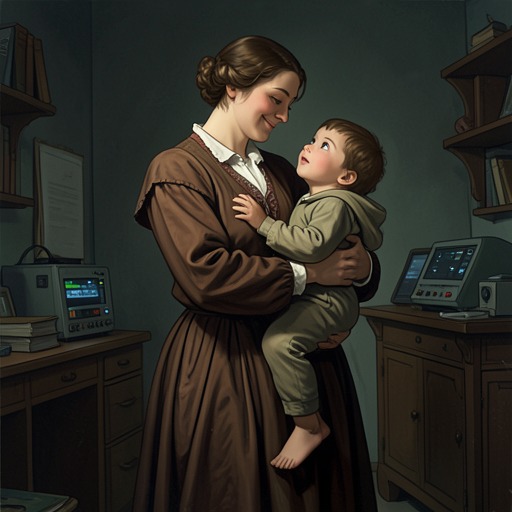
Rosa Dartle
David CopperfieldRosa Dartle is Mrs. Steerforth’s companion and James Steerforth’s old victim, bearing on her lip the scar he made when he threw a hammer at her as a boy. In David Copperfield’s retrospective account, her probing irony, attachment to the Steerforth household, and violent hostility toward Emily Peggotty turn that wound into more than a physical mark: it is a visible trace of James’s past violence and a focal point for the resentments gathered around his conduct.
Identity and Introduction
Rosa first appears at Mrs. Steerforth’s house in Highgate as a slight, dark woman with black hair and eager black eyes. An old scar cuts through her lip toward her chin, altering the shape of her upper lip; from across the dinner table it is barely visible, but David understands that it once formed a much more extensive wound. He estimates her age at about thirty and supposes that she wishes to marry. These are his first impressions, not facts established independently of his youthful, observant but fallible perspective.
Rosa lives in the house and has been Mrs. Steerforth’s companion for a long time. Her position places her close to the family without making her a member of it. The arrangement gives her sustained access to James Steerforth and his mother, while her dependent place in their household makes her presence easy for David to regard initially as a feature of the domestic scene rather than as a history in its own right. The book later supplies the crucial explanation for the scar: James caused it when they were young, after Rosa exasperated him. He rejects David’s suggestion that it resulted from an accident and describes having thrown the hammer at her. The injury therefore records an act of deliberate anger, not chance.
Speech, Observation, and Class
Rosa rarely states her meaning plainly. David notices that she hints at what she wants to say and enlarges its force through insinuation. When Mrs. Steerforth lightly suggests that James may have led a wild life at college, Rosa couches her response as an innocent request for information, pressing the implication while maintaining the pose of someone who merely wants correction. Her repeated questioning lets her challenge what others say without openly taking responsibility for a direct accusation.
That manner becomes especially sharp when the conversation turns to people of lower social standing. James dismisses their sensitivity and delicacy, treating their supposedly coarse natures as a reason to assume they suffer less. Rosa answers with pointed irony: she makes his argument sound comforting precisely because it permits the comfortable to disregard other people’s pain. Her performance of agreement exposes the cruelty beneath his distinction between them and us. The episode also establishes a pattern that recurs in her later encounters: Rosa listens for the injury hidden inside a polite account, then makes its implications difficult to evade.
David does not at first understand the full history behind her manner. When he remarks on the scar, James’s admission changes the significance of what David has seen, but does not make him wise to everything that follows. In the intervening visit to Highgate, Rosa’s hints and persistent questions draw out David’s account of events at Yarmouth. He is fond enough of James to speak freely, and he reports the family’s interest in what happened there. Rosa’s indirect method is thus not only a style of conversation; it enables her to gather information from a visitor who does not yet recognize how closely the household is watching the consequences of James’s actions.
James Steerforth and the Scar
Rosa’s relationship with James is shaped by a contrast between the old violence she carries and the charm he can exercise in the present. During a later visit, David observes James deliberately using his social skill to make her a more pleasant and pleased companion. Rosa resists, apparently angrily, even as her admiration grows and her expression softens. David mistakes James’s performance for evidence of a delightful nature and describes Rosa as jaundiced and perverse; in retrospect, his confidence in that reading becomes part of the narrative’s account of his own misjudgment.
The change in the room is striking but does not erase what preceded it. After Rosa’s manner has softened, James tells David that she is playing her harp and that, as far as he knows, no one but his mother has heard her play for three years. The private music suggests a side of Rosa that her cutting public manner does not disclose, yet the scene does not resolve the history between her and James. Her response to his charm remains visible as resistance as well as attraction, and David cannot establish what the performance means to her.
The scar returns as a visual measure of passion. In David’s perception, it becomes more pronounced when Rosa is agitated, lengthening across the lip and down her face; the portrait above the fireplace seems to shift between the faint mark he saw at dinner and the fuller wound he has seen when she is angry. He cannot forget the pictured face as he falls asleep, and wakes from dreams in which he is asking people whether things are really so. The portrait and the dream register the disturbance James’s confession has introduced into David’s otherwise comfortable stay, while showing how the scar has come to organize his perception of Rosa.
Hostility Toward Emily Peggotty
After James’s conduct toward Emily Peggotty becomes known, Rosa’s anger appears not as detached judgment but as an intense and punitive response. When Daniel Peggotty comes with David to appeal to Mrs. Steerforth, Rosa stands behind her chair. On the way out, she condemns David for bringing Daniel to the house, and strikes at her own scar as it throbs visibly with her agitation. Her gesture makes the old wound part of her confrontation with the man whose family she serves and whose son inflicted it.
Rosa then makes explicit the punishment she would impose on Emily. She would destroy Daniel’s home, have Emily branded and cast into the streets, and withhold even a word of comfort if Emily were dying. The fury of this speech is intensified by its setting: Daniel has come in distress to seek a hearing, and Rosa directs her wrath not at James but at the woman he has harmed. Her response does not offer Emily an alternative account of responsibility; it repeats the social condemnation that makes Emily’s disgrace an occasion for exclusion and humiliation. Daniel leaves to search for his niece, while Rosa’s outburst shows how sharply the household’s defense of its own standing can conflict with the injured family’s need for compassion.
Later, David recognizes Rosa entering the room where Emily is staying, and listens from an adjoining garret with Martha. Rosa says she has come to see Emily, whom she describes through the scandal attached to her relationship with James. When Emily protests that she had been brought up virtuously and was engaged to marry a good man, she also says that James used his power to deceive her and that she trusted and loved him. Rosa recoils and strikes at her, missing; her rage is so uncontrolled that David thinks he might have to intervene. The scene brings the two women into direct conflict over the meaning of James’s actions: Emily names herself as deceived, while Rosa treats her as an object of contempt and pollution.
Rosa eventually moves away from the door but leaves Emily with a threat. Unless Emily withdraws altogether from her reach or abandons what Rosa calls her mask, Rosa is resolved to cast her out. Her language preserves the same mixture of accusation and insinuation that marked her earlier conversations, but now its consequences are immediate: she claims the power to pursue and exclude Emily rather than merely to question her. Emily’s assertion of her own history receives no reconciliation from Rosa.
Narrative Role and Significance
Rosa’s characterization is built through the gap between outward appearance, indirect speech, and disclosed history. David first sees a scar, a sharp manner, and a companion whose questions seem to him eccentric; only James’s admission reveals that the wound came from an act of violence. Later events make Rosa’s anger legible in part, but do not simplify it into justice or make her a reliable advocate for the woman James has wronged. She recognizes the injury in what James says about people of lower status, yet directs extraordinary cruelty at Emily when Emily herself faces that contempt.
The retrospective narration preserves this contradiction rather than explaining it away. David records his own early assumptions, including his mistaken belief that James’s charm reflects a good nature, and sets them against what he later witnesses: the scar visibly changing with Rosa’s fury, her brief softening under James’s influence, and her attack on Emily. Rosa remains a figure whose history is partly exposed through another person’s confession and whose motives are not fully resolved by the account. The wound links James’s childhood violence to the later crisis, while Rosa’s shifting response to his charm and her hostility to Emily show how personal hurt can coexist with participation in the very cruelty that harms someone else.